

 English
 Español

Your stone grinder takes hours to reach the texture spec, and even then the particle size varies batch to batch. The colloid mill handles thin pastes reasonably well, but anything with a higher fat content clogs the gap and runs inconsistently. If you are producing hazelnut spread, praline paste, peanut butter, or pistachio cream at industrial scale — or planning to — the gap between what your current equipment delivers and what the market expects keeps getting harder to ignore. A Chocolate Ball Mill approaches nut paste processing differently from other wet grinding equipment, and under the right conditions, the difference shows up directly in texture, throughput, and processing consistency.
Content
- 1 What Makes Nut Paste Processing Different from Chocolate Refining
- 2 When Does a Ball Mill Outperform Other Grinding Options?
- 3 The Grinding Mechanism and Why It Suits Nut Paste
- 4 Comparing Equipment Options for Nut Paste Processing
- 5 Which Nut Pastes Are Particularly Well-Suited?
- 6 Conditions Where a Ball Mill May Not Be the Right Fit
- 7 Practical Considerations Before Specifying a Ball Mill for Nut Paste
- 8 Working with a Supplier Who Understands Both Equipment and Process
What Makes Nut Paste Processing Different from Chocolate Refining
The Fat Matrix Behaves Differently from Cocoa Solids
In chocolate refining, the fat phase — cocoa butter — melts at a defined temperature and creates a relatively stable suspension medium for sugar and cocoa particles. Nut pastes work differently. The fat released from grinding nuts is a mixture of fatty acids with varying melting points, and it does not behave uniformly across temperature changes the way cocoa butter does.
This means equipment that performs well on chocolate may behave unpredictably on nut paste if the temperature control system is not designed to handle a wider range of fat behavior. A ball mill with an active cooling and temperature management system handles this variability more reliably than equipment designed primarily for fixed-fat systems.
Particle Size Targets for Nut Pastes Vary by Product
Not all nut pastes require the same fineness. Tahini, for example, is typically consumed at a coarser grind than a hazelnut spread intended for confectionery filling. Praline cream for professional pastry applications has finer particle size requirements than commercial peanut butter.
The ability to control and reproduce a target particle size across production runs is where the Chocolate Ball Mill shows a consistent advantage over batch stone grinders and single-pass colloid mills. The grinding media, residence time, and agitator speed can be adjusted to hit a defined range and hold it.
When Does a Ball Mill Outperform Other Grinding Options?
High-Fat Pastes That Resist Even Grinding
Nut pastes with a naturally high oil content — including macadamia paste, pine nut paste, and high-fat peanut varieties — create challenges for equipment that relies on friction between surfaces to grind. As the paste becomes more fluid with released oil, surface-contact grinders lose grip and efficiency drops.
In a ball mill, the grinding action is distributed across the mass of steel or ceramic media suspended in the paste. The grinding does not depend on surface contact in the same way. High-fat pastes flow through the grinding media rather than glazing over a surface, which maintains grinding efficiency even as oil content rises during processing.
Continuous Production Requirements
Stone grinders and melangeurs operate in batch mode. Each batch requires loading, grinding to completion, unloading, and cleaning before the next batch begins. For producers managing significant volume, this creates capacity constraints and labor demands that do not scale efficiently.
The mill can be integrated into a continuous or semi-continuous production line. Material flows in at one end, is processed through the grinding zone, and exits at the other end at a defined particle size. This architecture suits production environments where throughput and consistency across shifts matter.
Recipes That Require Controlled Viscosity at Scale
Nut pastes used as inclusions in confectionery — praline fillings, gianduja, nut-based ganache bases — often have viscosity specifications that affect downstream processing. A paste that is too thick clogs depositors; one that is too thin affects the final texture of the inclusion.
Viscosity in nut paste is a function of particle size, fat content, temperature, and mechanical work input. This type of equipment gives the operator more levers to manage all four simultaneously than other available equipment. Residence time adjusts the mechanical work input; temperature control adjusts the fat behavior; feed rate adjusts the throughput-to-work ratio.
The Grinding Mechanism and Why It Suits Nut Paste
How the Ball Mill Reduces Particle Size
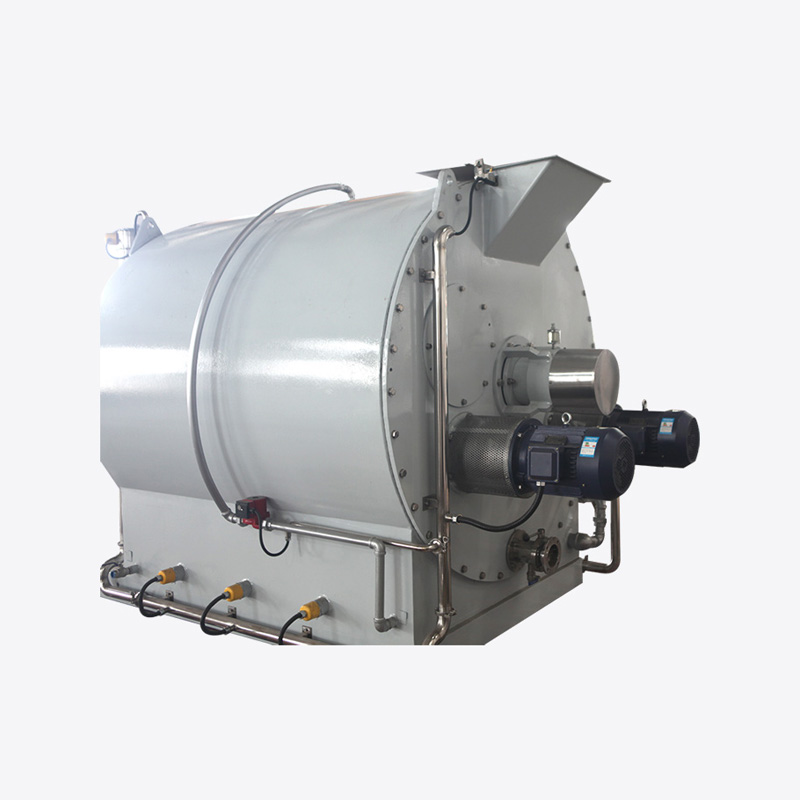
Inside a Chocolate Ball Mill, a cylindrical vessel is filled with a defined volume of grinding media — typically small stainless steel or zirconia balls. An agitator shaft drives movement through the media, and the material being processed is pumped through the media bed.
The grinding occurs through three mechanisms:
- Impact: particles are struck by moving media
- Attrition: particles are ground between media surfaces as they move past each other
- Shear: the fluid motion of the paste through the media creates shear forces that break down agglomerates
All three mechanisms operate simultaneously during processing, which produces a more uniform particle size distribution than single-mechanism grinding equipment.
Temperature Control Preserves Flavor Compounds
One of the practical concerns with nut paste processing is heat generation. Grinding releases energy, and in a poorly controlled system, that energy accumulates as heat. Elevated processing temperatures drive off volatile aromatic compounds responsible for fresh nut flavor, and can cause oils to oxidize in ways that shorten shelf life.
A unit with a jacketed vessel and active cooling manages heat removal as a controlled process parameter rather than an afterthought. The jacket circulates temperature-controlled water to maintain the paste within a defined range throughout the grinding cycle. This is particularly relevant for heat-sensitive pastes like pistachio and hazelnut, where flavor quality is a key product differentiator.
Comparing Equipment Options for Nut Paste Processing
How a Chocolate Ball Mill compares to other equipment commonly used for nut paste at a processing level is outlined, without ranking them — the right choice depends on production requirements.
| Equipment Type | Grinding Mechanism | Capacity Fit | Fat Tolerance | Temperature Control | Continuous Operation |
|---|---|---|---|---|---|
| Stone grinder / melanger | Surface friction | Small to mid batch | Moderate | Passive, limited | No |
| Colloid mill | Rotor-stator shear | Mid to high volume | Low–moderate | Limited | Yes, single pass |
| Roller refiner | Compression between rollers | Mid to high volume | Moderate | Limited | Yes |
| Chocolate Ball Mill | Impact, attrition, shear | Mid to high volume | High | Active, controlled | Yes |
| Bead mill (lab scale) | Impact and attrition | Small batch / R&D | High | Moderate | Semi |
The ball mill occupies a position that combines high fat tolerance, active temperature control, and continuous operation capacity — a combination that few other options in this category provide together.
Which Nut Pastes Are Particularly Well-Suited?
Hazelnut Paste and Praline Cream
Hazelnut paste for confectionery applications requires fine, consistent grinding to achieve the smooth mouthfeel associated with quality gianduja and praline cream. The fat released from hazelnuts during grinding has a relatively low melting point, which means processing temperature control is critical to prevent the paste from becoming too fluid or developing off-flavors.
The mill handles hazelnut paste well because the enclosed grinding system maintains the paste under temperature-controlled conditions for the full residence time. The particle size distribution achievable is consistent with confectionery-grade specifications.
Pistachio Paste
Pistachio paste is one of the more challenging nut pastes to process at scale due to its high sensitivity to heat and its relatively stiff texture at lower temperatures. Overprocessing — whether through excess heat or excess mechanical work — shifts the color from vivid green toward brown and degrades the flavor profile.
The combination of active cooling and controllable residence time in a ball mill gives the operator the ability to limit both thermal and mechanical exposure while still achieving the required particle reduction. This level of control is difficult to replicate with friction-based equipment.
Tahini and Other Seed-Based Pastes
Sesame-based pastes present a different challenge: the seeds have a harder outer structure than many tree nuts, and the paste tends to be quite fluid once fully processed. Equipment that relies on material viscosity to maintain grinding pressure can lose efficiency as the paste thins.
Because the grinding mechanism in this type of equipment does not depend on paste viscosity to maintain effectiveness, it handles the full range of sesame processing — from initial coarse reduction through to finished paste — without the efficiency drop that affects surface-contact equipment.
Conditions Where a Ball Mill May Not Be the Right Fit
Very Small Batch or Artisan Production
For producers making small volumes across a wide range of nut paste varieties, the cleaning and changeover requirements of a ball mill can outweigh the processing advantages. Small batch equipment — stone grinders, lab-scale bead mills — may be more practical at that scale.
The economics of a ball mill favor operations where run lengths are sufficient to amortize setup and cleaning time across a meaningful production volume.
Nut Pastes with Very Low Oil Content
Pastes with insufficient oil content to create a fluid medium in the grinding chamber can cause the grinding media to pack and create processing problems. A large share of commercial nut pastes have enough natural oil to avoid this, but some specialty pastes — particularly those where oil has been partially removed — may require pre-processing or oil addition before ball mill processing.
Practical Considerations Before Specifying a Ball Mill for Nut Paste
Before committing to this type of equipment for nut paste processing, a few operational questions are worth working through:
- Pre-grinding requirement: Raw nuts typically need coarse reduction before entering the ball mill. Is there an existing pre-grinding step, or does one need to be added?
- Cleaning protocol: Nut paste residue is oily and can become rancid if not fully cleared between runs. Confirm that the cleaning procedure for the specific unit is compatible with your production schedule.
- Material compatibility: Some nut pastes are acidic or contain compounds that interact with certain metal surfaces. Confirm that the grinding media and vessel materials are appropriate for your specific product.
- Heat exchanger capacity: For heat-sensitive pastes like pistachio, confirm that the cooling capacity of the jacket is sufficient to maintain the target temperature range under full production load.
- Integration with upstream and downstream equipment: The ball mill is one step in a production line. Its feed rate, discharge viscosity, and temperature output need to be compatible with what comes before and after.
Working with a Supplier Who Understands Both Equipment and Process
Specifying a Chocolate Ball Mill for nut paste processing is not just a matter of choosing a vessel size and a motor rating. The grinding media selection, agitator design, temperature management system, and discharge configuration all affect how well the equipment performs on a specific product. A supplier who has experience across a range of nut paste applications — not just chocolate — can help identify the configuration that fits the product and the production environment rather than offering a standard specification. Gusu Food Processing Machinery Suzhou Co.,Ltd. designs and manufactures Chocolate Ball Mills for industrial food processing applications, including nut paste and fat-based spread production. Their engineering team can work through application-specific requirements, provide trial processing support, and supply equipment documentation for integration into existing production lines. If you are evaluating ball mill options for a nut paste application, reaching out with your product type, target particle size, and production volume gives their team the context to recommend a configuration suited to your operation.