

 English
 Español

Content
- 1 Why Precision Tempering Is Now a Manufacturing Priority
- 2 How Chocolate Tempering Machines Control Crystal Formation
- 3 Comparing Types of Chocolate Tempering Equipment
- 4 Integrating Tempering Machines Into a Complete Production Line
- 5 Key Factors When Selecting a Chocolate Tempering Machine Manufacturer
Why Precision Tempering Is Now a Manufacturing Priority
Global chocolate consumption crossed 7.5 million metric tons in 2025, and buyers are less forgiving than ever about surface defects, inconsistent snap, or premature bloom. For manufacturers supplying retail shelves, foodservice chains, or ingredient markets, those defects translate directly into rejected batches and lost contracts. The pressure is pushing production teams away from manual temperature management and toward automated industrial chocolate tempering equipment for large-scale production that removes human variability from the equation.
Manual tempering works at a bench. At scale, it collapses. A chocolatier stirring a marble slab can adjust instinctively; a production line running 200 kg per hour cannot. Automated tempering machines hold temperature within fractions of a degree across every kilogram of chocolate mass, continuously, for an entire shift. That consistency is not a luxury—it is the baseline requirement for any serious manufacturing operation in 2026.
The investment case has also become easier to make. Energy-efficient designs, faster cycle times, and longer machine service lives have brought the total cost of ownership down significantly over the past decade. Factories that upgraded five years ago are already on their second generation of improvements, incorporating PLC controls and real-time monitoring that were once reserved for pharmaceutical processing lines.
How Chocolate Tempering Machines Control Crystal Formation
Cocoa butter is polymorphic—it can solidify into six distinct crystal forms, labeled Form I through Form VI. Only Form V produces the properties associated with premium chocolate: a high-gloss surface, a clean snap when broken, and a melt that begins precisely at body temperature. Peer-reviewed research on cocoa butter crystallization confirms that achieving Form V consistently requires precise multistage thermal control—not simply cooling melted chocolate and hoping for the right outcome.
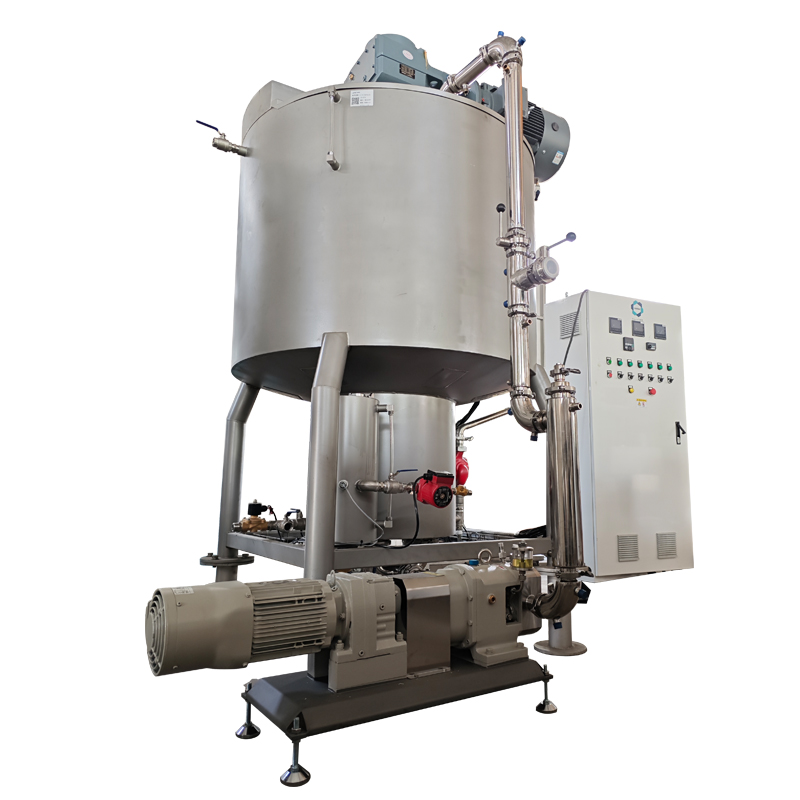
A chocolate tempering machine executes this process in three controlled stages. First, it heats chocolate fully—typically to 45–50°C for dark chocolate—to dissolve all existing crystal structures. Second, it cools the mass to approximately 27–28°C while continuously agitating it, seeding the formation of Form V nuclei. Third, it raises the temperature slightly to 31–32°C, which melts any unstable lower-form crystals that formed during cooling while leaving the Form V structure intact. The machine then delivers chocolate at this working temperature in a continuous, steady stream.
Modern industrial units automate all three stages through PLC-based control panels. Operators input the chocolate type—dark, milk, or white, each requiring slightly different temperature curves—and the machine manages the rest. Temperature sensors distributed through the heating and cooling circuits report in real time, triggering micro-adjustments before any deviation becomes visible in the finished product. The difference between a manually controlled process and this level of automation is the difference between acceptable and exceptional.
Comparing Types of Chocolate Tempering Equipment
Not every production environment needs the same solution. Tabletop units serve artisan workshops and R&D kitchens well; mid-range continuous machines handle bakery and confectionery lines; large-scale industrial temperers anchor high-volume manufacturing operations. The table below summarizes the key differences.
| Equipment Type | Typical Capacity | Hourly Output | Control System | Best Suited For |
|---|---|---|---|---|
| Mini / Tabletop | 5–20 kg | 10–30 kg/h | Manual / basic digital | Artisan workshops, R&D labs |
| Mid-range Continuous | 20–60 kg | 55–170 kg/h | Digital with auto control | Bakeries, confectionery SMEs |
| Industrial Continuous | 60–100+ kg | 200–300+ kg/h | PLC with real-time monitoring | Large factories, export-scale lines |
Beyond capacity, buyers should look at the cooling mechanism. Refrigerant-gas systems cool the auger screw directly and require no external water connection, simplifying installation in most factory layouts. Water-jacketed systems offer more uniform temperature distribution across larger tank volumes but add plumbing complexity. For operations running multiple chocolate types in a single shift, machines with saved program memory—storing separate temperature profiles for dark, milk, and white chocolate—eliminate manual reconfiguration and the errors that come with it.
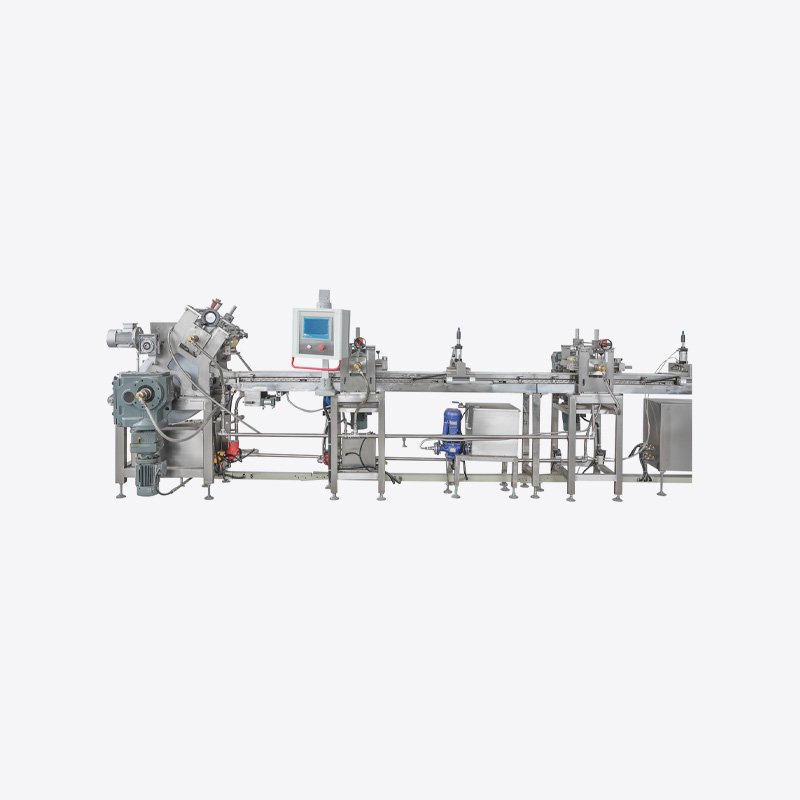
Continuous tempering is the format of choice for any line producing more than 50 kg per hour. Unlike batch systems that temper a fixed load and stop, continuous machines receive untempered chocolate at one end and deliver a steady, precisely tempered stream at the other—without interruption across an entire production run.
Integrating Tempering Machines Into a Complete Production Line
A tempering machine does not operate in isolation. Its output quality depends on what happens upstream, and its throughput determines what is possible downstream. Understanding these dependencies is what separates a well-designed production line from a bottlenecked one.
Upstream, chocolate mass arrives at the temperer after refining and conching. The texture and viscosity of the incoming mass—determined by the fineness of grinding and the duration of conching—directly affect how evenly the tempering machine can distribute heat and seed crystals. Using chocolate conching machines that develop flavor before tempering ensures the incoming mass has the right particle size and moisture profile, giving the temperer consistent input to work with.
Downstream, tempered chocolate moves immediately into moulding, enrobing, or depositing operations. The transition must happen quickly and at the correct working temperature—any delay or temperature drift begins undoing the crystallization work. After moulding or enrobing, the product enters a cooling tunnel. Stainless steel cooling tunnels that solidify tempered chocolate hold the formed products at controlled temperatures—typically 12–18°C—for 15 to 45 minutes, locking the Form V structure before the product is handled or packaged.
When tempering, conching, and cooling equipment come from the same manufacturer, integration is significantly smoother. Flow rates, connection fittings, and control interfaces are designed to work together, reducing the engineering time needed to commission a new line and the maintenance complexity over its operating life.
Key Factors When Selecting a Chocolate Tempering Machine Manufacturer
The machine specification matters, but so does the organization behind it. A tempering machine that performs well on day one but proves difficult to service six months later creates more disruption than a slightly lower-specification unit backed by responsive technical support. Procurement teams evaluating suppliers should look across several dimensions simultaneously.
Temperature precision and repeatability should be confirmed with documented data, not marketing claims. Ask for tolerance specifications across the full operating range and verify whether those tolerances hold at maximum throughput—some machines drift at capacity.
Certification matters in export markets. Machines certified to CE standards meet European safety and electrical requirements; ISO 9001 certification on the manufacturing facility signals quality management processes that reduce the probability of component failures. For food contact surfaces, SUS304 stainless steel is the accepted standard, offering both corrosion resistance and cleanability that regulatory auditors expect.
Customization capability separates commodity equipment from purpose-built solutions. Tank size, auger configuration, connection points, and control interface language can all affect how efficiently a machine integrates into an existing facility. Manufacturers with in-house R&D teams can accommodate these requirements; pure trading companies reselling standard models typically cannot.
Finally, evaluate the after-sales structure. Spare parts availability, remote diagnostics, and on-site service response time are worth asking about in detail before signing a purchase order. The best tempering machine in the world creates zero value when it is waiting three weeks for a replacement sensor.