

 English
 Español

Granola bars are no longer limited to one simple combination of grains and sweeteners sitting on a shelf. Consumers now encounter products with different textures, flavors, coatings, fillings, and nutritional positioning scattered across the snack aisle, and that variety keeps growing every season.
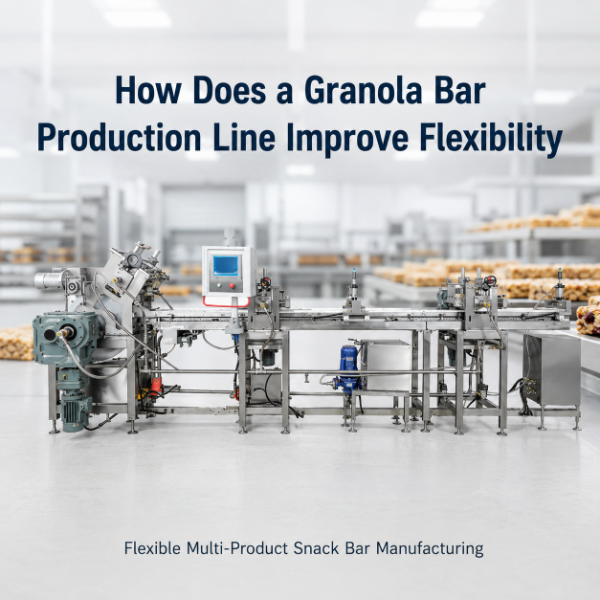
This shift is changing how manufacturers think about a Granola Bar Production Line, with a lot more attention going toward flexible production, product changeovers, ingredient handling, packaging coordination, and the ability to support different bar formats inside one manufacturing environment. A single production floor increasingly needs to wear several hats at once.
A modern production line needs to do more than just move ingredients from one stage to the next in a straight line. Manufacturers may need to run cereal bars in the morning, switch to coated snack bars by early afternoon, and finish the day on a completely different recipe with its own texture. The design trend is therefore moving toward production systems that can accommodate changing product requirements without turning everyday operation into something unnecessarily complicated for the crew running it.
Content
- 1 Why Is Product Variety Influencing Granola Bar Production Line Design?
- 2 How Is Multi-Product Manufacturing Changing Line Flexibility?
- 3 Why Are Protein Bars Affecting Production Line Design?
- 4 How Is Granule Addition Changing Snack Bar Production?
- 5 Why Are Chocolate Coatings Becoming Part of Flexible Bar Production?
- 6 How Is Automated Packaging Influencing Production Line Layout?
- 7 What Role Does Equipment Flexibility Play in Future Bar Manufacturing?
- 8 How Are Manufacturers Balancing Automation With Practical Operation?
- 9 How Is Sustainable Product Development Affecting Bar Production Choices?
Why Is Product Variety Influencing Granola Bar Production Line Design?
The snack aisle contains many types of bars these days, and shoppers pick products based on taste, texture, ingredients, portion format, or whatever eating occasion they have in mind that morning. A Granola Bar Production Line therefore needs to support more than a single recipe if a manufacturer actually wants to respond to that broader product range on store shelves.
Traditional bar production often focused on one established product running the same way every day. Newer manufacturing strategies instead consider how the same production environment can handle several related products without starting from scratch each time.
| Product Type | Production Consideration |
|---|---|
| Granola bars | Handling mixed grains and binding ingredients |
| Cereal bars | Forming different cereal-based mixtures |
| Energy bars | Managing varied ingredient combinations |
| Coated bars | Coordinating bar forming with coating |
| Filled bars | Allowing additional filling processes |
| Snack bars | Supporting changes in shape and texture |
This shift doesn't mean every factory needs some highly complicated system bolted onto the floor. Manufacturers are mostly looking for practical ways to make equipment and production stages work across several product categories without duplicating everything twice over.
A flexible layout also makes it a lot easier to introduce new recipes without tearing apart and rebuilding the entire production area from the ground up. That matters quite a bit in a market where product development often involves fairly small tweaks to an existing bar concept rather than a total reinvention.
How Is Multi-Product Manufacturing Changing Line Flexibility?
Multi-product manufacturing is becoming a genuinely important consideration, since factories may need to serve several customer requirements at the same time on the same floor. A manufacturer producing only one type of bar faces a very different planning challenge than a facility juggling cereal bars, protein products, coated snacks, and seasonal recipes all at once.
A flexible Cereal Bar Line can help support this wider production approach by letting related products pass through shared stages wherever that makes sense. The idea isn't simply bolting on more equipment every time a new recipe shows up.
Manufacturers need to think through how ingredients enter the process, how mixtures get formed, how bars move between stages, and how finished products eventually reach packaging. A practical production layout may include the following stages.
- Ingredient preparation.
- Mixing and forming.
- Bar handling.
- Optional coating or topping.
- Cooling or setting.
- Packaging.
The exact arrangement depends heavily on the product range and whatever the specific factory actually needs. When shared production stages get planned carefully from the start, manufacturers can cut down on unnecessary duplication while still keeping room open for different recipes.
This approach also makes future product development a lot less painful down the road. A new cereal combination or a fresh coating style may only require adjustments to certain stages, rather than demanding an entirely separate manufacturing route built from scratch.
Why Are Protein Bars Affecting Production Line Design?
Protein bars have added a fair bit of extra variety within the broader snack bar category over the past several years. Their ingredients and texture often differ quite a bit from conventional granola or cereal products, which means manufacturers may need a production system built to accommodate different mixtures and forming characteristics side by side.
A Protein Bar Extrusion Line becomes relevant here, since extrusion can support shaping certain bar mixtures into a continuous form before they get divided into individual pieces. The production concept needs to actually match the characteristics of the recipe running through it, not the other way around.
Some protein-based products carry a dense, chewy texture, while others include grains, nuts, seeds, or other inclusions mixed throughout.
| Protein Bar Feature | Design Consideration |
|---|---|
| Dense mixture | Smooth material movement |
| Grain inclusions | Controlled ingredient handling |
| Nut or seed pieces | Careful movement through production stages |
| Soft texture | Gentle product handling |
| Coating | Integration with later finishing stages |
Manufacturers are therefore paying close attention to flexibility, rather than designing equipment narrowly around one single recipe that might change next season anyway. A production line built to accommodate related product types tends to leave more room open for ongoing product development.
This proves especially useful for facilities that want to manufacture both protein-focused products and more traditional snack bars under the same roof, without running two completely separate operations side by side.
How Is Granule Addition Changing Snack Bar Production?
Texture has become a genuinely important part of the eating experience for a lot of snack bar buyers. Granola bars and cereal bars may contain visible grains, seeds, nuts, fruit pieces, crisps, or other inclusions that give the finished product a distinct appearance and mouthfeel someone actually notices while eating it.
This creates another design consideration worth thinking through for production lines. Ingredient additions need handling in a way that preserves the intended mixture while keeping the rest of the production process running consistently.
Granule addition can happen at different points depending on the recipe and production method in use. The layout should make it possible to introduce these ingredients without creating unnecessary disruption to the main process running alongside it.
A cereal-based mixture, for example, may call for larger grain pieces, while another snack bar recipe might rely on much smaller inclusions instead. The production system should reflect the actual physical nature of the ingredients involved, rather than treating every recipe the exact same way regardless of what's going into it.
This trend also connects closely with product appearance on the shelf. Visible ingredients can become part of a product's identity, so manufacturers often consider how the production process affects their distribution and final presentation once the bar is wrapped.
The goal isn't simply piling in more ingredients for the sake of it. It's creating a process that supports the intended texture and appearance while staying practical for regular, everyday manufacturing runs.
Why Are Chocolate Coatings Becoming Part of Flexible Bar Production?
Chocolate coatings can change both the appearance and the eating experience of a snack bar pretty dramatically. A simple cereal bar can turn into a coated product through one additional finishing stage, opening up more opportunities for manufacturers to develop different product variations from the same base recipe.
This has a real impact on production line design, since coating can't get treated as some isolated activity bolted on at the end. The bar needs to arrive at the coating stage in a suitable condition, move through the process smoothly, and continue toward packaging without a lot of unnecessary handling along the way.
A flexible line therefore needs space built in for optional finishing stages that not every product actually requires.
| Finishing Style | Production Role |
|---|---|
| Full coating | Covers the main surface of the bar |
| Partial coating | Adds a different visual effect |
| Chocolate drizzle | Creates a decorative finish |
| Granule topping | Adds visible texture |
| Plain finish | Keeps the original bar appearance |
Not every product needs every finishing option running on it. The important trend here is modular thinking, where manufacturers can pick the stages a particular product actually needs, rather than forcing every recipe through the exact same path regardless of fit.
This supports a broader product portfolio while keeping the overall production concept reasonably organized on the floor. Coating also creates another connection point with packaging, since the finished surface needs to stay presentable as the bar moves toward wrapping, making the relationship between processing and packaging increasingly important to plan around.
How Is Automated Packaging Influencing Production Line Layout?
Packaging is no longer simply the last step tacked onto the end after production wraps up. As manufacturers handle more product varieties at once, packaging needs to work in real coordination with the rest of the line, rather than sitting off to the side as its own separate concern.
Automated packaging can help cut down on the amount of manual handling required between finished bar formation and final packing. The packaging stage may need to accommodate different bar sizes, product formats, wrappers, or secondary packaging arrangements depending on whatever's actually running through the line that day.
This makes flexibility a genuinely important part of packaging design overall. A production line can perform well at the forming stage but still create delays further down the line if the packaging area can't handle that same variety without bottlenecking.
Manufacturers are therefore looking at the complete path running from ingredient preparation all the way to finished goods. A coordinated layout may include the following stages working together.
- Product forming.
- Surface finishing.
- Cooling or setting.
- Product transfer.
- Individual wrapping.
- Group packaging.
- Finished product handling.
The purpose here is creating a continuous workflow, rather than treating each stage as its own separate operation disconnected from the rest. Automation also supports more consistent product movement throughout the process.
When bars move through connected stages with fewer manual transfers along the way, the production environment tends to become a lot easier to organize and keep track of. This doesn't mean every single operation needs to be fully automated, though. Manufacturers may choose automation where it offers real practical value, while still keeping human involvement in areas that call for inspection, adjustment, or careful product handling.
What Role Does Equipment Flexibility Play in Future Bar Manufacturing?
Product development rarely stays completely still for long. A manufacturer might start out with a simple granola bar and later add a chocolate-coated version, a cereal-based recipe, or a protein-focused product to the lineup as demand shifts.
This makes equipment flexibility increasingly relevant to how a factory gets planned from the start. A production system built around adaptable stages tends to leave a lot more room open for these kinds of changes down the road.
Manufacturers may consider whether their equipment can support different mixtures, bar shapes, finishing methods, and packaging formats without turning everyday operation into an unnecessarily difficult process for the crew running it.
Flexibility also applies directly to production planning on a given week. A factory may need to switch between products during the same working shift, which makes cleaning, adjustment, and product changeover genuinely important parts of the overall design rather than an afterthought.
The line should let workers understand clearly what needs to change and exactly where that change happens. Clear product flow can make these transitions a lot easier to manage without confusion on the floor.
| Flexible Design Area | Manufacturing Benefit |
|---|---|
| Product forming | Supports different bar styles |
| Ingredient handling | Accommodates varied recipes |
| Finishing | Allows optional coatings or toppings |
| Product transfer | Connects different processing stages |
| Packaging | Supports multiple finished formats |
| Layout | Leaves room for future adjustments |
Flexibility doesn't necessarily mean piling in every possible function a line could theoretically support. A sensible design starts with the manufacturer's actual product range on hand and leaves practical room for whatever changes come along later.
How Are Manufacturers Balancing Automation With Practical Operation?
Automation is changing how snack bar factories approach production these days, but the goal isn't simply removing people from every single stage of the process. Modern line design often focuses on reducing repetitive handling while keeping production genuinely easy to monitor and adjust when something needs attention.
This balance matters quite a bit because food production involves constant changes in recipes, ingredients, packaging, cleaning routines, and product schedules week to week. A highly complicated system can end up creating its own operational headaches if workers can't easily follow what's actually happening on the floor in front of them.
Manufacturers therefore tend to look for automation that supports clear product movement and reasonably straightforward control. Examples include automated product transfer, coordinated packaging, ingredient feeding, and organized handling between processing stages that don't require constant manual intervention.
Human workers stay important for tasks like checking product appearance, managing recipe changes, maintaining cleanliness, and responding to unusual situations that pop up unexpectedly. The relationship between people and equipment is genuinely becoming part of production line planning itself, not just an operational detail sorted out later.
Good design should make routine work easier without piling on unnecessary complexity for the sake of looking advanced. This matters especially for facilities producing several types of snack bars at once, where a flexible production environment needs workers who understand how different products actually move through the same general system. Clear layouts and practical operating procedures support that understanding day after day.
How Is Sustainable Product Development Affecting Bar Production Choices?
Sustainability is also shaping the direction of snack product development quite a bit lately. Manufacturers may explore recipes using different grains, seeds, plant-based ingredients, or other components tied to shifting consumer preferences around health and environmental impact.
These recipe changes can influence production requirements in ways that ripple through the whole line. Ingredients with different textures or handling characteristics may call for adjustments to mixing, forming, transfer, or packaging stages that weren't needed with the old recipe.
Packaging itself is another piece worth considering here. As companies explore different packaging approaches, production lines may need to accommodate changes in wrapping materials, package formats, or secondary packing arrangements that come along with those choices.
The trend runs broader than just swapping ingredients around, though. Manufacturers are increasingly considering how product formulation, processing, packaging, and factory organization all fit together as one connected system rather than separate decisions made in isolation.
A Granola Bar Production Line designed with practical flexibility in mind can make it a lot easier to respond to these shifts, without treating every single product change as a completely new manufacturing project starting from zero. This doesn't guarantee every new recipe will run smoothly on existing equipment without any changes at all. It simply means flexibility is becoming a genuinely useful consideration to build in during the design stage itself.
The same thinking carries over to a Cereal Bar Line and a Protein Bar Extrusion Line too, particularly for manufacturers who want to develop several related snack products within one shared production environment rather than running separate operations for each.