

 English
 Español

Equipment problems in chocolate production have a way of surfacing at the worst possible moments — mid-batch, during a peak production run, or just before a delivery deadline. A grinding chamber that has not been properly cleaned carries contamination risk into the next product. Bearings that have gone too long without lubrication start running hot and noisy before they fail entirely. Steel balls that have worn down past their useful size stop producing the fine particle distribution that makes chocolate smooth. For factories running a Ball Mill Machine for Chocolate day after day, maintenance is not a separate activity from production — it is part of what keeps production viable over the long term.
Content
- 1 What Makes Chocolate Ball Mill Maintenance Different from Standard Industrial Equipment?
- 2 How Should the Grinding Chamber Be Cleaned?
- 3 Why Does Grinding Media Condition Matter So Much?
- 4 What Lubrication Does a Chocolate Ball Mill Require?
- 5 How Do You Build a Preventive Maintenance Schedule?
- 6 What Are the Most Common Failure Points to Watch For?
- 7 How Does Maintenance Affect Chocolate Quality Consistency?
- 8 Maintenance and Food Safety: Where Do They Overlap?
- 9 What Spare Parts Should Always Be on Hand?
- 10 Protecting the Equipment Investment Over Time
What Makes Chocolate Ball Mill Maintenance Different from Standard Industrial Equipment?
Most industrial machinery tolerates a degree of residue, dust, and minor contamination without immediate consequence. A chocolate ball mill operates differently because the product itself is the contamination risk. Chocolate contains fat, sugar, and milk solids that can oxidize, develop off-flavors, or support microbial growth if left in contact with machine surfaces between production runs.
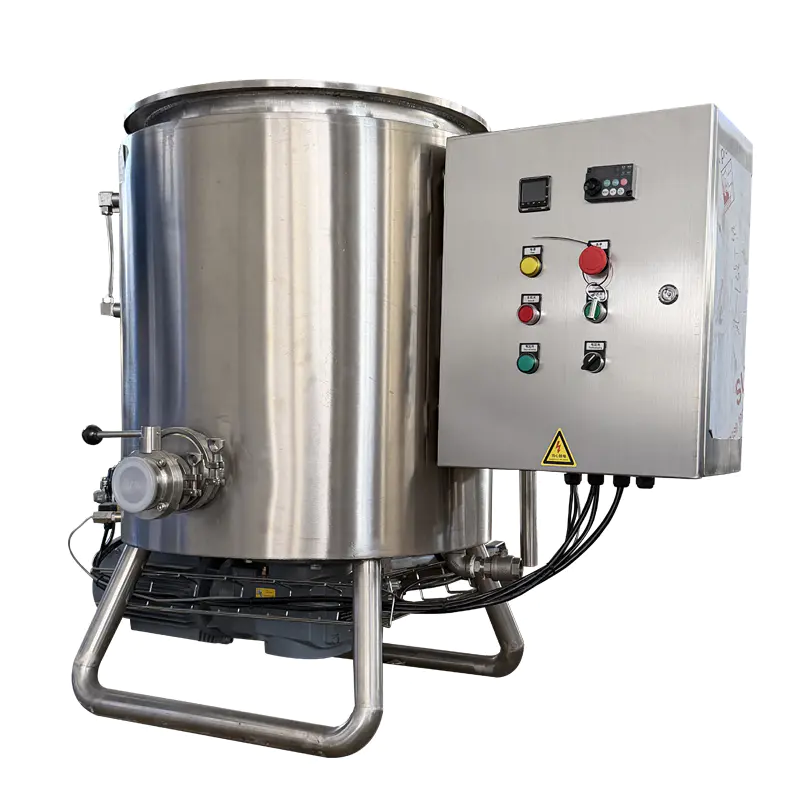
This creates a maintenance environment shaped by two overlapping demands:
- Mechanical reliability — keeping the motor, bearings, drive system, and grinding chamber in working condition
- Food safety compliance — ensuring that every surface in contact with chocolate is clean, free of residue, and appropriate for food-grade production
Both matter, and they require different approaches. Mechanical maintenance follows wear cycles and operating hours. Food safety cleaning follows production cycles — sometimes every batch, sometimes every shift, depending on the product and the facility's quality protocols.
How Should the Grinding Chamber Be Cleaned?
Cleaning the grinding chamber is the maintenance task that happens most frequently, and it is also the one where shortcuts create the most visible problems.
Chocolate residue hardens when it cools. If the chamber is not emptied and cleaned while the machine is still warm from operation, residue begins to set against the chamber walls, the agitator, and the grinding balls. Once hardened, it is harder to remove and more likely to contaminate the next batch.
A practical cleaning sequence after each production run:
- Allow the machine to finish processing and drain all product completely
- While the chamber is still warm, flush with a small quantity of food-grade cocoa butter or vegetable fat to lift residue from surfaces — this is sometimes called a fat wash
- Drain the flush material fully and wipe down accessible internal surfaces
- For scheduled deep cleaning, disassemble accessible components and clean with food-safe detergents according to the facility's sanitation protocol
- Allow all surfaces to dry completely before reassembly — moisture in a chocolate processing environment causes immediate product quality problems
The fat wash step is often overlooked in busy production environments, but it significantly reduces the time and effort required for full cleaning and extends the interval between deep cleans.
Why Does Grinding Media Condition Matter So Much?
The steel balls inside a ball mill for chocolate making are not passive components — they are the actual grinding mechanism. Their size, shape, and surface condition directly determine what particle size the finished chocolate reaches.
New grinding balls are spherical and smooth. Over time, they wear. They become smaller, less round, and develop surface irregularities. As this happens, the grinding dynamics inside the chamber change. The contact pattern between balls shifts. The spaces between balls change in size. The energy transfer during each collision becomes less predictable.
The practical consequence is that particle size distribution in the chocolate drifts. A batch that used to finish at the target fineness in a given time starts taking longer. Or it finishes within the same time but the particle size is coarser than specification.
Monitoring grinding media involves:
- Periodic removal of a sample of balls to check average diameter against original specification
- Visual inspection for balls that have cracked, chipped, or developed flat spots
- Checking whether the total volume of grinding media in the chamber has decreased noticeably — worn balls are smaller, and if they have not been topped up, the effective fill level drops
- Replacing worn balls gradually rather than all at once, which avoids a sudden shift in grinding performance
Keeping detailed records of when balls were added and in what quantities helps predict replacement intervals rather than reacting after quality problems appear.
What Lubrication Does a Chocolate Ball Mill Require?
Lubrication requirements vary by machine design and manufacturer specification, but the general areas that need attention are consistent across most ball mill chocolate machine configurations.
Bearings carry the rotating load of the mill shaft and agitator assembly. They require periodic lubrication with a grease or oil specified for food-adjacent environments — in some cases, food-grade lubricants are required depending on the proximity to product contact surfaces. Under-lubricated bearings run hot, generate noise, and eventually seize. Over-lubricated bearings can push grease past seals and into areas where it does not belong.
Gearboxes and drive components require oil level checks and periodic oil changes according to the manufacturer's service intervals. Gearbox oil degrades over time, losing its protective properties as it accumulates metal particles from normal gear wear. Running degraded oil accelerates wear on gear surfaces and increases the risk of unexpected failure.
Seals and gaskets are not lubricated in the traditional sense, but they require regular inspection as part of lubrication maintenance rounds. A seal that has hardened, cracked, or displaced allows lubricant to migrate where it should not go — and in a food processing environment, lubricant contamination of product is a serious quality and compliance issue.
A simple lubrication log — recording what was lubricated, with what product, and when — is one of the more practical tools for preventing the kind of neglect that shows up as bearing failures months down the line.
How Do You Build a Preventive Maintenance Schedule?
Reactive maintenance — fixing things after they fail — is considerably more expensive than preventive maintenance. Unplanned downtime in chocolate production disrupts not just the machine but the entire batch, the temperature management system, and potentially the delivery schedule. Building a structured maintenance schedule turns sporadic attention into a reliable system.
A workable maintenance schedule for a chocolate ball mill typically organizes tasks by frequency:
After each production run:
- Drain and fat-wash the grinding chamber
- Check the discharge valve and outlet for residue buildup
- Wipe down external surfaces, including the jacket connections for temperature control
Weekly:
- Inspect bearing housings for unusual heat or vibration
- Check drive belt tension and condition
- Verify that the temperature control system (jacket water or oil) is functioning correctly
- Review grinding time against recent batches to catch early signs of media wear
Monthly:
- Check gearbox oil level and condition
- Inspect seals and gaskets around the grinding chamber and shaft entry points
- Sample grinding media for wear assessment
- Lubricate bearings according to manufacturer specification
Quarterly or semi-annually:
- Full gearbox oil change
- Deep mechanical inspection of agitator shaft, impeller, and chamber liner
- Motor inspection — check for unusual heat, vibration, or noise under load
- Review and update spare parts inventory
The exact intervals depend on production intensity and machine design. A factory running continuous shifts needs shorter intervals than one running single daily batches.
What Are the Most Common Failure Points to Watch For?
Some components fail more frequently than others, and knowing where to focus attention saves time during inspection rounds.
Shaft seals are a high-frequency failure point in chocolate ball mills. The seal sits at the entry point of the rotating shaft into the grinding chamber. It is exposed to both the mechanical stress of rotation and the chemical environment of liquid chocolate. When it begins to leak, chocolate migrates along the shaft and can reach the bearing or gearbox. Catching seal degradation early — before it produces a visible leak — is a matter of checking for slight discoloration or buildup at the seal face during routine inspections.
Agitator pins or discs are the internal components that move the grinding balls through the chocolate mass. In heavy-duty production, they experience significant wear from repeated contact with the balls. Worn agitator components reduce the energy transferred to the grinding media, which lengthens batch time and increases power consumption without any obvious external signal.
Temperature control connections — the fittings and hoses that carry heating or cooling water or oil through the machine jacket — are prone to slow leaks at fittings and gradual hose deterioration. A temperature control system that is losing fluid slowly will show inconsistent jacket temperatures, which affects batch consistency before the leak becomes obvious.
Drive belts stretch over time and can slip under load. Slipping belts reduce the rotational speed delivered to the mill, again extending batch times and creating inconsistent results across production runs.
How Does Maintenance Affect Chocolate Quality Consistency?
The connection between machine condition and product quality is direct but easy to underestimate during day-to-day operations.
Particle fineness in chocolate is determined by how long the product spends in the mill and how effectively the grinding media is working. When media wears and is not replaced, fineness drifts coarser. When the agitator components wear, energy transfer to the balls decreases and grinding slows. When the temperature control system underperforms due to a maintenance issue, chocolate viscosity during grinding changes, which affects how the product flows through the ball bed and the final texture of the finished product.
None of these effects happen overnight. They develop gradually, which means quality problems traced back to machine condition are often attributed to recipe variation or raw material differences before anyone checks the equipment. Building maintenance records that run alongside quality records makes these connections visible.
Maintenance and Food Safety: Where Do They Overlap?
A comparison of maintenance tasks by their primary concern:
| Maintenance Task | Mechanical Reliability | Food Safety Relevance |
|---|---|---|
| Chamber cleaning after each run | Low direct impact | High — prevents residue buildup and cross-contamination |
| Grinding media inspection | High — affects output quality | Moderate — worn media can shed fragments |
| Bearing lubrication | High — prevents mechanical failure | Moderate — lubricant type must be appropriate |
| Seal inspection | High — prevents leaks | High — seal failure allows contamination pathways |
| Gearbox oil change | High — protects gear surfaces | Low if sealed from product contact |
| Temperature system checks | Moderate — prevents performance drift | Moderate — affects product consistency |
| Deep clean and disassembly | Low direct mechanical benefit | High — addresses areas missed in routine cleaning |
| Agitator wear inspection | High — affects grinding efficiency | Low direct food safety impact |
The overlap between mechanical and food safety maintenance is not complete — some tasks serve one concern more than the other. A balanced maintenance program addresses both rather than treating them as separate concerns managed by different teams.
What Spare Parts Should Always Be on Hand?
Waiting for spare parts to arrive while a production line sits idle is an avoidable cost. Maintaining a working inventory of the components most likely to need replacement keeps downtime short when something does go wrong.
Parts worth keeping in stock:
- Shaft seals and O-rings for the grinding chamber entry points
- Drive belts in the correct specification for the machine
- Bearing sets for the main shaft and agitator
- A quantity of replacement grinding balls to top up wear losses
- Temperature control fittings and hose sections
- Gaskets for the chamber cover and discharge valve
The specific parts depend on the machine design, but the principle is consistent: high-wear, high-failure-consequence components should be available immediately, not on order.
Protecting the Equipment Investment Over Time
A ball mill for chocolate making represents a significant capital investment, and how it is maintained determines how long that investment remains productive. Machines that receive structured, consistent attention — cleaning after every run, lubrication on schedule, media replacement before quality drifts, bearing inspections that catch problems early — simply run longer and more reliably than those maintained reactively. The cost of a planned maintenance program is measurable and predictable. The cost of an unplanned failure mid-production is harder to quantify but consistently higher. For chocolate manufacturers looking to build or refine their maintenance approach, working with a supplier who understands the operational demands of the equipment makes that process considerably more straightforward. Gusu Food Processing Machinery Suzhou Co.,Ltd. supports chocolate producers not just at the point of equipment supply but through the operating life of the machine, offering technical guidance on maintenance requirements and spare parts management for factories that want to protect both their equipment and their product quality over the long term. If your current maintenance program has gaps or your machine is showing signs of performance drift, a conversation with an experienced equipment supplier is a practical place to start.